Custom website vs template: Wix, Squarespace and WordPress themes compared
A template only puts a basic page online. A custom website brings in customers. Here’s the comparison, with sources.
Custom website vs template: the short answer
A template is a finished design sold to many businesses. You fill in your words and photos. Wix and Squarespace rent you one inside their platform. A WordPress theme is a template you install and look after yourself.
Custom website design starts from your business instead: how you sell, what customers search for, and what has to happen after someone taps “contact.” The site is built around that.
- A template is limited to a layout made for everyone, so it can’t be built around how you sell.
- A custom website is built to rank, look like the leader in your market, and turn visitors into leads, orders or bookings.
Templates cost less on day one. The question is what they cost you after that.
Custom website vs template, side by side
| Wix or Squarespace template | WordPress theme | Custom website from outdated | |
|---|---|---|---|
| Who builds it | You, on top of running your business | You, or a freelancer you have to find and manage | We do, for you |
| Built around | A layout made for someone else | A layout made for someone else | Your business and your customers |
| Looks like | Every other site on the same template | Every other site on the same theme | Only you |
| Google and AI search | Settings you have to learn and fill in yourself | Plugins you have to find, install and configure yourself | SEO for Google and AI search, built in |
| Extra pages | You write, design and publish every one yourself | You write, design and publish every one yourself | 100+ extra pages, free, each answering something your customers search for |
| Google reviews | None built in. You find, set up and manage an add-on yourself | None built in. You find, install and maintain a plugin yourself | A system that keeps new reviews coming |
| Leads and orders | Separate apps you install, connect and manage yourself | Separate plugins you install, connect and keep updated yourself | Your own CRM, payments and metrics |
| An app | None included | None included | Your own app in the App Store and Google Play |
| Cost | Less on day one, much more in lost sales over time | Less on day one, much more in lost sales over time | A clear price before anything starts |
| Time to launch | Several weeks, depending on how fast you learn and build | Several weeks or longer, depending on who builds it | Live in 7 days |
Wix and Squarespace: you’re renting
Builders look easy. The catch is that the site lives on their platform and works only there.
Wix says it plainly: “your site must run on Wix’s servers.” (Wix Help Center)
Changing your mind later is harder than it looks. Also from Wix: “it’s not possible to switch to a different template for a site you already created.” (Wix Help Center)
Squarespace lets you export some content, in a WordPress format. But “Not everything will export, as many features rely on our platform’s JavaScript and CSS.” Style settings, custom CSS and store pages stay behind. (Squarespace Help Center)
So the years you put into a builder site stay with the builder. Your domain can move. The design, and most of the site, stay behind.
What about an app? Templates and themes don’t include one. We build your own app in the App Store and Google Play. Our guide Does my business need an app? shows what it does for your business.
WordPress themes: you guard it yourself
A WordPress theme puts the work on you. You host it, update it and keep it safe yourself.
That makes you the security team. Patchstack, which tracks WordPress security, counted 11,334 new vulnerabilities in the WordPress ecosystem in a single year. It also found that “91% of new vulnerabilities were found in plugins, and 9% were found in themes,” and that “46% of vulnerabilities were not fixed in time for public disclosure.” (Patchstack)
A theme plus a stack of plugins means someone has to keep watching it.
Template websites end up looking alike
The most popular templates are used by huge numbers of businesses. That’s the problem.
One WordPress theme, Avada, says “1,050,000+ People Trust Avada.” (Avada) Builders run a big share of the web too. W3Techs counts Wix on 4.2% of all websites and Squarespace on 2.4%. (W3Techs)
That’s a lot of businesses starting from the same bones. Your site ends up looking like someone else’s.
Website design decides trust
Customers judge your business by your website before they ever meet you.
In a Stanford study of 2,684 people, “nearly half of all consumers (or 46.1%) in the study assessed the credibility of sites based in part on the appeal of the overall visual design of a site, including layout, typography, font size and color schemes.” (Stanford Web Credibility study)
If your work is better than your website, customers only see the website.
Template websites and speed on phones
Many customers meet your business on a phone first. Google found that “53% of visits are likely to be abandoned if pages take longer than 3 seconds to load.” (Google)
Google also scores how a page loads and behaves with three checks called Core Web Vitals. The HTTP Archive’s Web Almanac looked at real mobile sites on each platform. The share passing all three was 40% on WordPress, 57% on Wix and 60% on Squarespace. (HTTP Archive Web Almanac)
Read that the other way: even on the best of the three, about 4 in 10 sites failed. A design made to fit every kind of business can carry features yours never uses. Custom website design lets the site carry only what it needs.
Why a website template is weak
A template is made to fit everyone, so it holds your business back:
- You’re limited to a basic page with your hours, address and contact details, not a site built to bring in leads.
- You’re limited to the template’s layout. Your site looks like every other business on the same template.
- You’re stuck doing the work. You write every page, set up every setting and keep it all updated yourself.
- You’re left relying on referrals, because a template isn’t built to rank when people search for what you sell.
- You’re limited to what the platform allows. Leads, orders and bookings go through its add-ons, not a system built for you.
What a custom website does for your business
A custom website is built for the job your website has to do:
- It’s built to rank when people search Google or ask AI tools for what you sell.
- It brings in business: leads, orders, appointments and product sales.
- Your brand looks as good online as your work really is.
- Every lead, order and booking lands in one place.
- Your own app keeps your business on your customers’ phones.
What a template costs vs a custom website
A template costs less on day one. In the long run it costs much more. A site that looks like everyone else’s looks less credible and carries less authority, so the business loses sales, deals and customers to competitors who look like the leader.
Does a custom website take longer to build?
Many guides say a custom website takes weeks or months. Ours don’t. Websites and apps go live in 7 days.
We were established in 2017. We’ve built for 2,000+ businesses, and we made $100 million+ for clients in a year. Every build is custom, never a template, and done for you.
Every build is also made to rank on Google and AI search.
Custom websites we built
A few custom websites and apps we built, none of them from a template:
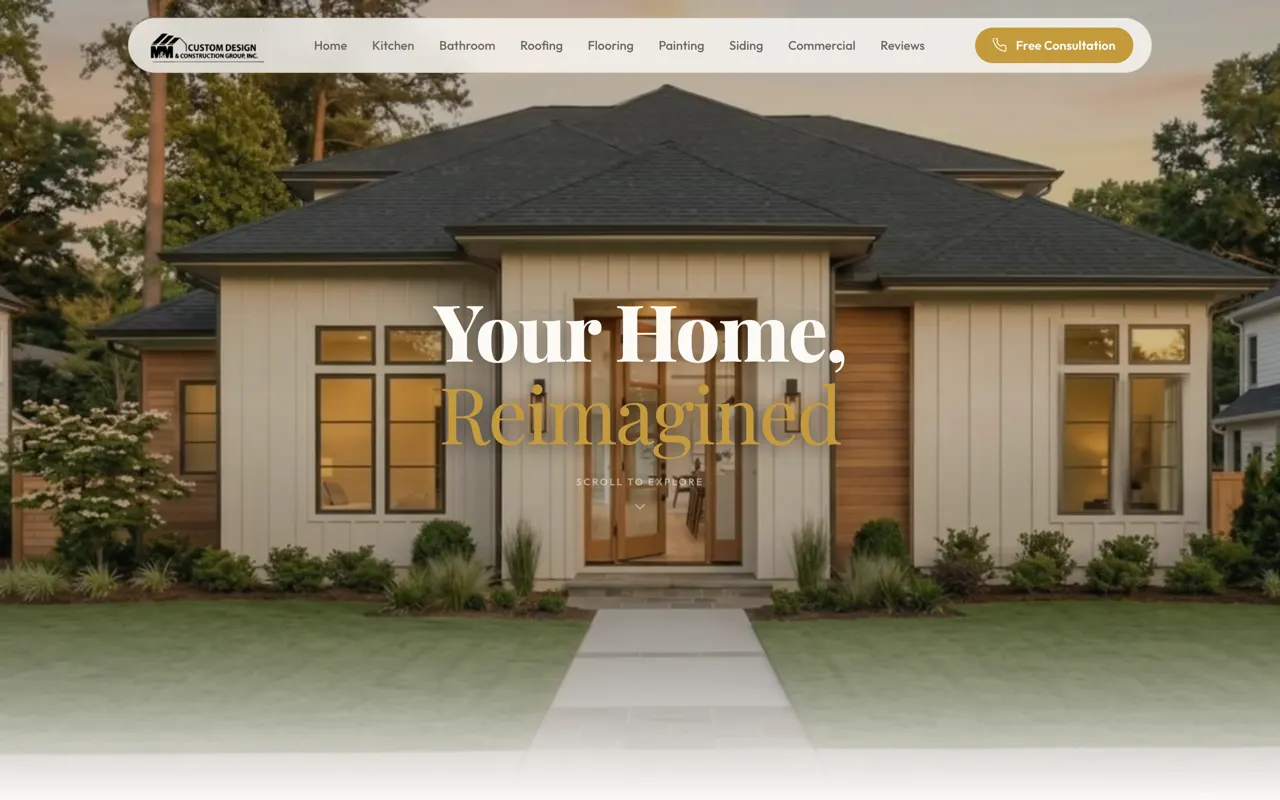
- MM Custom Design: a website for a home renovation and construction company.
- Suhoor Festival: the festival’s website and its app in the App Store.
- Muir Energy: an online store for a food brand.
- Wowbooza: a website for a dessert shop.
Looking for a Wix alternative?
If your site runs on Wix, Squarespace or a WordPress theme, another builder won’t fix what’s holding it back. Your business needs a site built around how it actually gets customers. Our website redesign guide covers the signs it’s time.
Switching is simpler than most owners expect. Your domain stays yours, and Wix lets you transfer it away. Because a Wix site can’t run anywhere else, we build the new one from scratch: your words, your photos, and a new design made for how you sell.